Choose timezone
Your profile timezone:
Our Cluster Assembly 2026 will be held in Siegen from Monday, 13th July, to Wednesday, 15th July. On Monday, we will start at 10:00 with coffee and registration. Monday evening is free and can be used for self-organised sub-group meetings. Tuesday evening, we plan to have a common dinner at the upper castle. On Wednesday, we plan to finish around 16:00.
In case you never visited Siegen before, some hopefully inspiring pictures below. Siegen currently has slightly over 100.000 inhabitants and a long history dating back to Celtic times, when iron was already produced. In 1972, the university was founded, which has around 15.000 students. Downtown Siegen offers many pubs, restaurants, and cafes, as well as theaters, cinemas, and concert halls, which you hopefully will be able to attend.
The meeting venue is the former high school for girls, Lÿz, which is now used as a centre for culture.
 © Aleksei Rusov |
 © Aleksei Rusov |
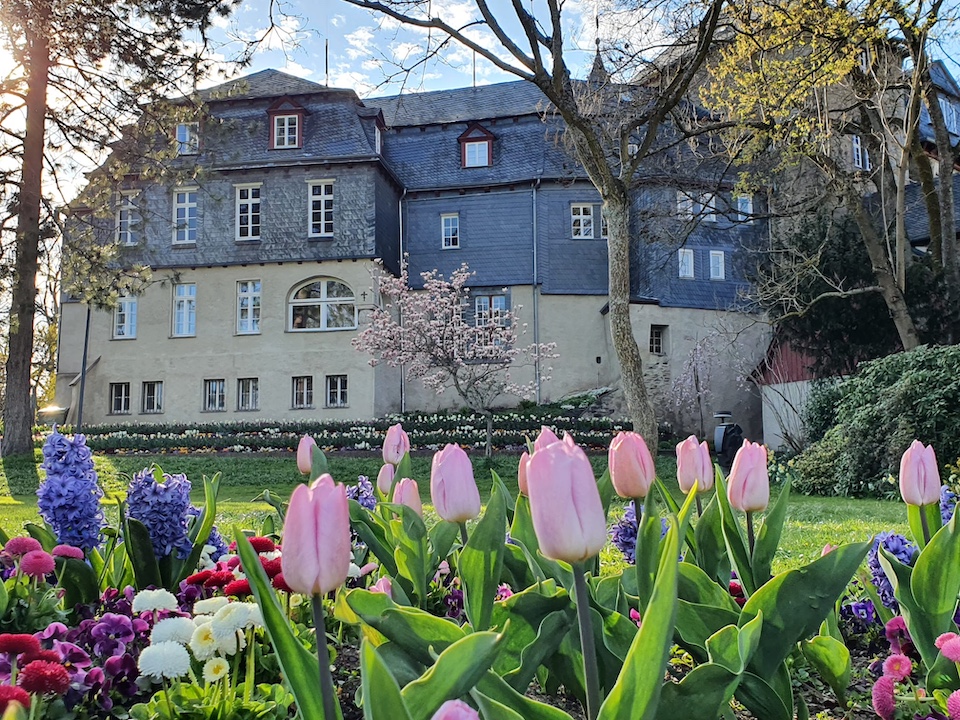 © Aleksei Rusov |
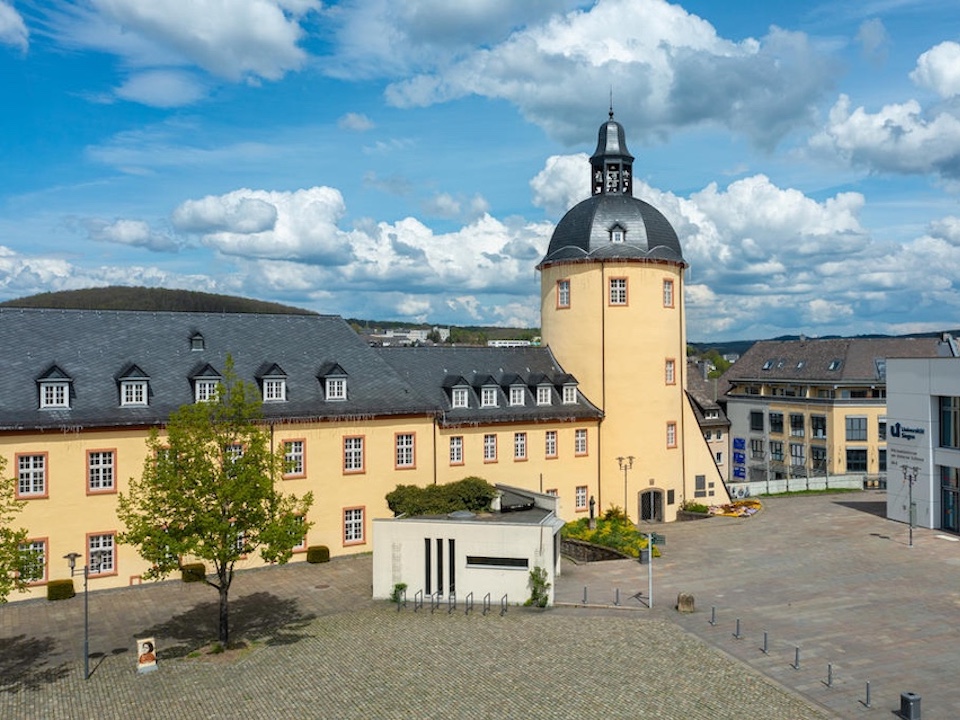 © University of Siegen |
Standard Model extensions with light axions are well-motivated by the observed Dark Matter abundance and the Peccei-Quinn solution to the Strong CP Problem. Such axions can have flavor-violating couplings to SM fermions at tree-level, which are predicted in scenarios where global flavor symmetries address the SM flavor puzzle. I will discuss how flavor-violating couplings allow for efficient axion production from the decays of SM particles, giving the opportunity to probe axion Dark Matter in precision flavor experiments, core-collapse supernovae and the early Universe.
While the charmonium spectrum below the open-charm threshold is well established, the situation above threshold remains murky. Conventional charmonium states become broader and less well explored. At the same time, a wealth of new, potentially exotic hadrons—the XYZ states—challenge the conventional quark-model picture. The BESIII experiment, using e+e− annihilation to produce pairs of charm and anti-charm quarks, is particularly well suited to study the spectrum of those charmonium(-like) hadrons that have the same quantum numbers as the photon: the vector states. In this talk, I will present an overview of the experimental situation around the vector states above the open-charm threshold, and our ongoing efforts towards an interpretation of the data.
Precision studies of the Standard Model of elementary particle physics cover energy scales ranging from multiple TeV in measurements of top quark and Higgs boson properties, down to below the hadronic scale, where quark-flavour-changing transitions of mesons and baryons place stringent constraints on new physics. At all energies QCD plays a crucial role, confining partons inside of hadrons at low energies and leading to jet topologies at high energies. In this talk I will take you on a journey from high energies and perturbative calculations, down to decays of hadrons and the non-perturbative form factors required in their description. I will emphasize connections between multi-loop Feynman integrals and the parametrisation of form factors, semileptonic decays and resonance poles, as well as common limiting factors in the determination of CKM matrix elements and the top quark mass.
Quark confinement in hadrons is a well-established phenomenon. However, a complete quantitative understanding of the principles governing the quark configurations realized in nature remains elusive. Such an understanding is crucial in the context of ongoing searches for physics beyond the Standard Model in decays to multi-body hadronic final states. To address this, we study the excitation spectra of light mesons, including searches for exotic states that defy the rules of the traditional quark model.
We discuss measurements of the non-strange and strange light-meson spectrum at the COMPASS experiment. A comprehensive partial-wave analysis of the $K^-\pi^-\pi^+$ final state yields a broad spectrum of strange mesons and identifies the first candidate for an exotic strange-meson signal with $J^P=0^-$.
Furthermore, we present studies from the Belle II experiment. We report on experimental challenges in charged particle identification and discuss a search for $C\!P$ violation in $B \to K\pi\pi$ decays utilizing amplitude analyses. Finally, we present ongoing efforts to study light mesons in multi-body hadronic $\tau$-lepton decays and the prospects for measuring the spin quantum state of $\tau$ pairs produced in the $e^+e^-$ collisions.
Decays of $b$-hadrons provide precision probes of the Standard Model (SM) and constitute one of the most promising avenues for uncovering physics beyond it. In recent years, several tensions between experimental measurements and SM predictions have highlighted the need to critically reassess theoretical predictions. In view of the substantial increase in the amount of data from the high-luminosity phase of the LHC and the Belle II experiment, precise theoretical predictions with well-controlled uncertainties will be indispensable to fully exploit the discovery potential of these experiments.
From a theoretical perspective, $b$-hadron decays involve a wide range of energy scales, from the electroweak scale down to the hadronic scale of the strong interactions. In this context, effective field theories provide a systematically improvable framework that serves as a key tool for achieving the required level of precision. They allow for a separation of perturbative and non-perturbative effects, while power-counting rules determine the scaling of subleading contributions, which is crucial for reliable uncertainty estimates.
In this talk, I will give an overview of my work on precision calculations for $b$ decays using effective theories. I will discuss recent advances in the QCD factorization approach to exclusive non-leptonic $B$-meson decays, including QED corrections, power corrections in the heavy-quark expansion and a new strategy towards lattice determinations of a crucial non-perturbative input, the $B$-meson light-cone distribution amplitude. Furthermore, I will discuss a novel approach to describe non-factorisable soft-gluon contributions in rare $B$ decays and ongoing efforts to include radiative corrections to charm-loop contributions in inclusive $\bar{B} \to X_s \gamma$ channels. Lastly, I will highlight some methodological synergies between heavy flavor physics and precision calculations for Higgs-boson and top-quark production at the LHC.
Semileptonic B decays are shadowed by two persistent puzzles: a ~3-sigma tension between inclusive and exclusive determinations of |Vcb| and |Vub|, and a related lepton flavour universality deviation seen in R(D(*)) and other tau/light-lepton ratios. A third, less-discussed issue may connect the two: the hadronic composition of B -> Xc l nu, including the long-standing "gap" between inclusive and summed-exclusive branching fractions, enters as a systematic input to both programs. Belle II, at the SuperKEKB e+e- collider, offers a uniquely clean environment to advance all three fronts. Closing in on these puzzles with the precision they demand requires progress along two complementary axes: extracting more information out of every collision through better measurement strategies and modelling, and simply delivering more collisions by keeping the accelerator running at its full potential.
On the measurement side, I present progress along three directions: new determinations of |Vcb| and |Vub| exploiting improved tagging and modelling techniques, world-leading tests of lepton universality enabled by improved particle identification, and ongoing efforts to resolve the semileptonic gap through dedicated searches and inclusive moment analysis.
On the data side, I present efforts to protect and maximize SuperKEKB luminosity through machine-learning-based anomaly detection: deep learning forecasting models that flag Sudden Beam Loss precursors ahead of conventional monitors, complementary techniques to localize their source, and progress toward real-time deployment on dedicated hardware.
The absence of direct evidence for physics beyond the Standard Model at the Large Hadron Collider has shifted the focus towards precision measurements as a complementary discovery strategy. In this talk, I will present my research program spanning both the energy and flavor frontiers, illustrating how precision measurements can probe new physics at energy scales beyond the direct reach of current experiments.
The first part of the talk reviews my contributions to precision Higgs measurements within the ATLAS experiment, including the development of the first Simplified Template Cross Section (STXS) measurement in the H→ττ channel and its role in global Higgs coupling measurements and Effective Field Theory interpretations.
The second part focuses on my current research at the Belle II experiment, where I pursue precision measurements of fundamental τ-lepton properties, including the τ lifetime and mass. Particular emphasis will be placed on their impact on tests of lepton flavor universality and precision electroweak physics. I will also present ongoing studies of rare radiative τ decays, which provide unique sensitivity to charged-current dynamics, hadronic structure, and possible light, weakly coupled new-physics mediators.
Together, these measurements demonstrate how precision studies at collider and flavor experiments provide complementary and increasingly powerful approaches to exploring physics beyond the Standard Model.
Reliable theoretical predictions for QCD processes at collider experiments require perturbative calculations beyond leading order. A central challenge in these computations is the treatment of infrared singularities arising from virtual corrections and unresolved real radiation. Over the past decades, a variety of subtraction methods have been developed to address this problem, enabling increasingly precise predictions for collider observables. In this talk, I will review the current state of the art in the construction of fully general subtraction schemes for arbitrary scattering processes, with particular focus on the recently generalised nested soft-collinear subtraction method.
Modern machine learning (ML) is enabling increasingly precise studies of the Standard Model that were previously beyond experimental reach. Sensitive measurements across energy scales, such as the Higgs self-coupling and the top-Higgs Yukawa coupling, are vital to understanding the nature of the Standard Model and potentially uncovering evidence of new physics. I present a research program that applies cutting-edge AI algorithms across the experimental pipeline in order to drive sensitivity in top quark and Higgs boson measurements, demonstrated through two recent CMS analyses. I present the first study of Higgs production decaying to two W bosons with at least one hadronic W, which is enabled by transformer-based jet tagging and fine-tuning techniques. I also discuss the first measurement of four-top production in the all-hadronic final state, which is facilitated by ML-driven event discrimination and data-driven background estimation. I then talk about how ML is changing how we collect data in collider experiments, through the example of AXOL1TL, the first ML-based anomaly detection algorithm operating in the CMS hardware trigger. Finally, I discuss the development of next-generation jet reconstruction algorithms, including symmetry-preserving attention networks for multi-Higgs and multi-top hadronic final states. Together, these developments, spanning trigger hardware, offline reconstruction, and physics-level interpretation, illustrate how AI-driven innovation is deepening our understanding of the Standard Model while extending our reach beyond it.
Despite their remarkable success in describing the universe, cracks are appearing in both the standard model of particle physics and the standard model of cosmology. These discrepancies not only hint at the presence of physics beyond these standard models but also highlight the necessity of understanding them more thoroughly. This need is especially pronounced in the context of dynamics crucial to cosmology and heavy-ion or collider physics.
In this talk, I will discuss progress spanning anomalous transport and axion dynamics, thermalization in first-principle simulations of 1+1 dimensional quantum dynamics, and how concepts from quantum information theory can provide novel perspectives on the phase structure of quantum field theories.